

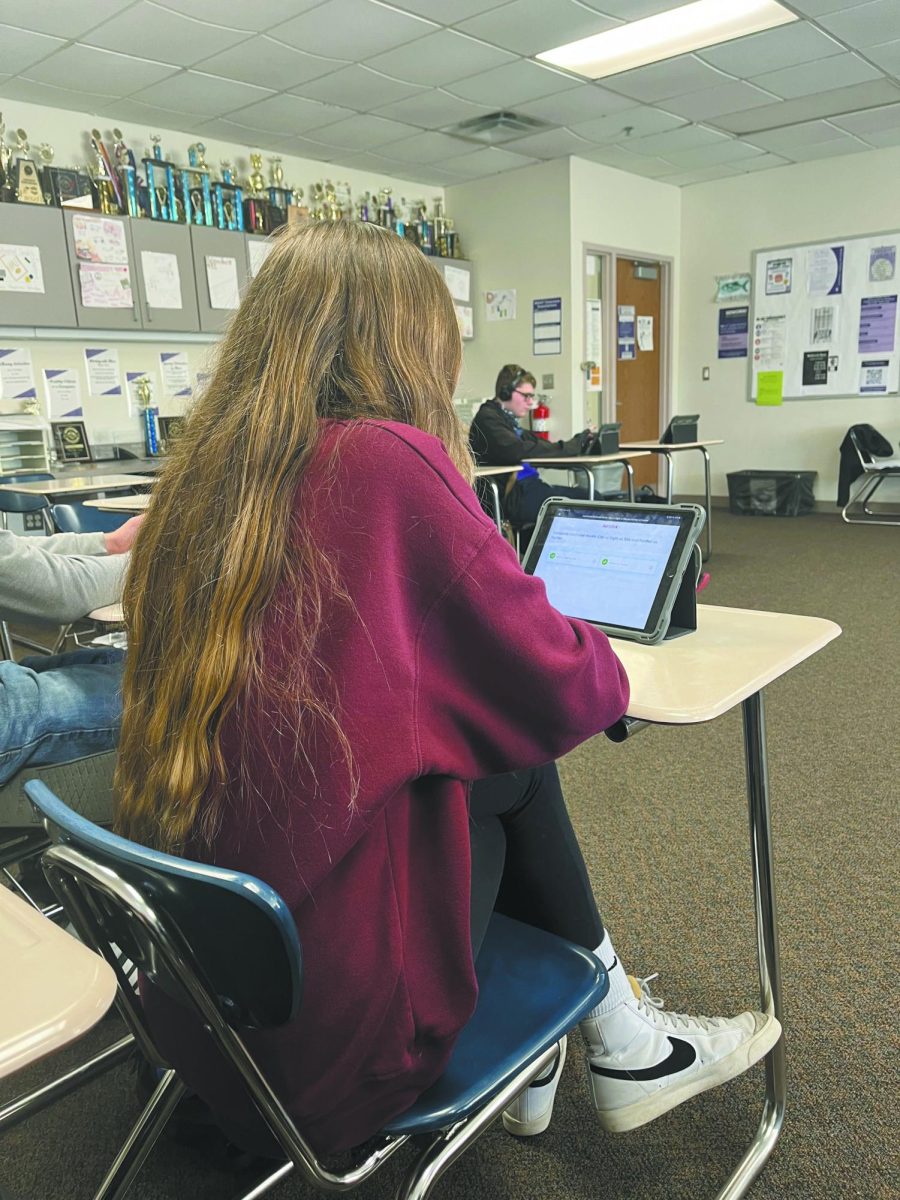
Students sit at a desk filling out question after question for a program called No Red Ink, meant to make them better at English grammar. Each question done means promoting a program with artificial intelligence (AI), even if the tool they’re using isn’t AI. Each question wrong means three more added to the list of ongoing grammar problems that they are practicing.
The Bellevue Public School district started using AI in English classrooms to help improve ACT scores. However, some teachers have brought up concerns about.
“I don’t love it because of its environmental and ethical concerns,” English instructor David Bossman said.
Multiple students have shared worries about the use of AI in the classroom, and the National Education Association, or NEA, has also expressed concerns for how AI usage will affect the environment. Though AI could help with learning, the NEA recommends that educators consider both the carbon footprint and ethical concerns.
“It’s proven to see that AI negatively impacts the environment by using tons of water to go off their systems and as they’re producing carbon emissions,” sophomore Chase Parson said.
Some English teachers had started using AI programs to help students with learning grammar, but have stayed away from the actual AI components, or stopped using them all together.
“I was using [Quill] until I had some students express concerns about the environmental impacts of AI,” English instructor Carla Palo said. “So I stepped back from that to kind of see if there’s maybe another platform I could use that doesn’t utilize AI.”
Quill is an AI program that Palo was using in the English 12 AP classes for seniors. Similarly, No Red Ink, another AI program, was bought by the district for teachers to use to help increase English ACT scores.
“I think using AI for learning is kind of redundant, because it doesn’t help you learn,” Parson said. “So I personally don’t like the use of AI.”
The No Red Ink program is not entirely made up of AI elements, and Bossman doesn’t use any of the AI tools in his day to day classroom. On the website, small quizzes with differing topics can be taken to help students learn and use different sentence structures correctly, and these programs do not use AI.
“Right now, I’m just kind of using it with frequently tested skills on the ACT English,” Bossman said. “I’m trying to kind of go through where I think I have noticed the most often missed sort of stuff.”
As some teachers don’t use the AI components and others have started to avoid them all together, they try to find other ways to increase ACT scores. Multiple students have expressed their preference towards the teachers doing the explaining rather than an online tool.
“I think instead of using AI to solve the low ACT scores, they should focus on more hands-on experiences, and the easiest way to learn is through a teacher who knows what they’re talking about,” Parson said.